Rubio’s Uzbekistan Visit Signals a New US Push for Influence Across Central Asia
US Secretary of State Marco Rubio visited Uzbekistan to strengthen American trade, investment and diplomatic ties across Central Asia, a strategically important region with extensive economic connections to Russia and China. The visit brought together regional officials and a large US business delegation, with agreements worth approximately $12 billion announced as Washington seeks new commercial opportunities and more diversified access to critical mineral resources.
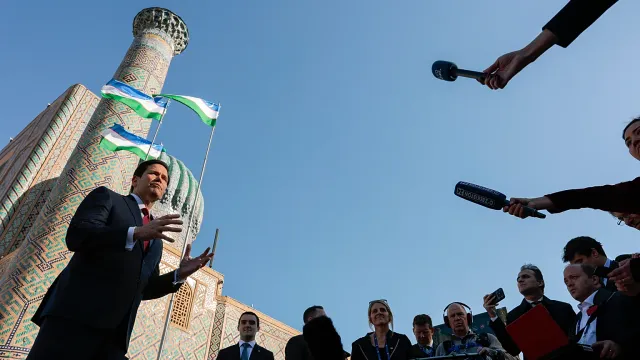
Washington Steps Up Its Engagement With Central Asia
SAMARKAND, Uzbekistan — October 19, 2026
The United States is intensifying its efforts to build stronger economic and diplomatic relationships across Central Asia, with Secretary of State Marco Rubio visiting Uzbekistan for high-level talks aimed at expanding American influence in a region long shaped by Russian and Chinese interests.
Rubio arrived in the historic Silk Road city of Samarkand on Sunday evening before meeting foreign ministers from Kazakhstan, Kyrgyzstan, Tajikistan, Turkmenistan and Uzbekistan on Monday. The discussions took place under the C5+1 framework, which brings Washington together with the five Central Asian republics to address shared economic, diplomatic and security priorities.
The visit had a substantial commercial focus. More than 200 American business representatives accompanied Rubio, according to the US State Department, reflecting Washington’s interest in developing new markets, attracting investment opportunities and strengthening supply chains for strategically important resources.
The trip also included meetings with Uzbek officials and business leaders, as well as discussions intended to deepen cooperation between American companies and regional partners.
Economic Agreements Take Centre Stage
Trade and investment were central to the visit, with the United States and Uzbekistan announcing an investment agreement covering multiple sectors that the parties said would total approximately $12 billion when implemented.
The announcements point to growing opportunities for cooperation in infrastructure, industrial development, energy, finance and technology. However, the headline figure represents planned agreements rather than money already invested or projects fully completed.
For American businesses, Central Asia offers access to developing consumer markets, transport corridors connecting Europe and Asia, and substantial reserves of natural resources. For governments across the region, greater cooperation with the United States could bring additional investment, technological expertise and access to international markets.
Uzbekistan also signed the Artemis Accords, a US-led international agreement establishing principles for peaceful space exploration and the use of space resources. The move represents another area in which Tashkent is seeking to expand its international partnerships.
Critical Minerals and Strategic Competition
A major motivation behind Washington’s renewed engagement is the importance of critical minerals to advanced manufacturing, electronics, energy technologies and defence industries.
The US government has been seeking to reduce its dependence on concentrated supply chains, particularly those connected to China. Central Asia’s mineral resources therefore present a potential opportunity to diversify supplies and develop new commercial partnerships.
Rubio stressed that American companies wanted a fair opportunity to compete in the region. Washington’s approach is to encourage commercial relationships that allow local economies to develop their resources while providing American firms with opportunities to participate in extraction, processing and related industries.
Nevertheless, the United States faces established competition. China benefits from geographic proximity, extensive infrastructure connections and substantial trade relationships, while Russia retains historical, economic and political ties throughout the region.
Central Asian governments are therefore balancing relationships with multiple global powers rather than committing exclusively to one partner.
Uzbekistan Seeks a Broader International Role
Uzbekistan has increasingly pursued a foreign policy centred on economic development, international investment and cooperation with a wider range of countries.
Its position at the heart of Central Asia makes it an important participant in regional transport and trade networks. Its government has also sought to attract foreign companies and expand industrial capacity as part of its broader economic development strategy.
Rubio’s visit provided an opportunity for Uzbekistan to strengthen ties with Washington while continuing its established relationships with Beijing, Moscow and other international partners.
The timing was particularly significant. Chinese Premier Li Qiang had met Uzbek President Shavkat Mirziyoyev shortly before Rubio’s arrival, highlighting the attention major powers are paying to the country.
The contrast illustrates a wider regional trend: Central Asian governments are using their strategic location and resource base to attract competing sources of investment and expand their diplomatic options.
Diplomacy Beyond Immediate International Crises
Rubio’s visit also came amid criticism that Washington’s diplomatic priorities should focus more heavily on urgent international conflicts, including the war in Ukraine and instability in the Middle East.
The secretary of state defended the importance of maintaining long-term relationships alongside efforts to manage immediate crises. He argued that diplomacy must also create opportunities for future economic cooperation rather than concentrating exclusively on emergencies.
His position reflects the administration’s view that economic partnerships can strengthen American influence over time, particularly in regions where other major powers already have significant advantages.
During discussions concerning Ukraine, Rubio reiterated Washington’s position that Russia and Ukraine should work toward ending the war, while warning of the risks of further escalation.
The broader message was that the United States intends to remain engaged across multiple regions, even as it faces competing foreign policy demands.
A Long-Term Test for US–Central Asian Relations
Despite the announcements, the success of Washington’s approach will depend on whether diplomatic commitments translate into completed investments, sustainable business relationships and measurable economic benefits.
The region’s governments have strong incentives to maintain diversified partnerships. American companies must compete with established Chinese and Russian businesses, while regional economies need financing, infrastructure and reliable access to international markets.
For the United States, closer cooperation with Central Asia could support mineral supply diversification, create export opportunities and strengthen diplomatic relationships in a strategically important part of Eurasia.
For Uzbekistan and its neighbours, stronger ties with Washington offer another source of investment and international cooperation without requiring them to abandon existing relationships.
Rubio’s visit therefore represents more than a series of diplomatic meetings. It signals a renewed American effort to establish a lasting economic presence in Central Asia, where commercial opportunities and geopolitical competition are increasingly intertwined.
Whether this momentum produces lasting results will depend on implementation: the investments completed, the businesses that establish operations and the economic value ultimately delivered to the countries involved.